Online Poker vs Blackjack: Which Card Game Fits You?
Blackjack and online poker are two of the most visible card games in casinos, but they’re fundamentally different animals. One is a head‑to‑head battle against a fixed system; the other is a market of players trying to outthink each other. If you’ve sat at an online table and wondered which game better suits your temperament, bankroll and goals, this piece lays out the practical differences—using the numbers and observations operators and experts publish—so you can decide with your eyes open.
Core structural differences: who are you actually playing?
Start with a simple question: who are you trying to beat? In blackjack you’re playing the dealer (the house). Every hand is resolved against the dealer’s predetermined rules—hit until 17, stand otherwise, and so on—so the interaction is mechanical and transparent. That’s the point emphasized in this comparison from Blackjack Review and other operator-facing writeups: blackjack is a “house game with a known mathematical edge.” See the Blackjack Review comparison for more background: Blackjack Review: Online Blackjack Versus Online Poker.
Poker is almost the opposite. Online poker rooms charge a fee (rake) and let players compete against one another—your winnings come from other players, not from the site. That means your long‑term success depends on how much better you are than the field, not on a fixed game bias. Blue Lake Casino’s primer explains this cleanly: Blue Lake Casino's blackjack vs poker overview.
Why this matters: when you play blackjack you’re facing a built‑in house expectation every hand; in poker you’re facing a constantly shifting set of human opponents, and your edge is relative rather than absolute.
House edge, rake and long‑run expectation
One of the clearest practical differences between the games is the payoff calculus.
- Blackjack: With standard rules and correct basic strategy, the house edge typically sits around 0.5%–2% of the wager. Rule tweaks—number of decks, whether the dealer hits or stands on soft 17, or a dreaded 6:5 payout for blackjacks instead of 3:2—can move that number materially. The typical operator breakdown is well summarized in operator material and game guides such as Blue Lake’s discussion and broader guides like the one from WinStar: WinStar's Blackjack vs Poker comparison.
- Poker: There is no fixed house edge on the game outcomes. Instead the poker room takes a cut of the action—rake—typically in the 2.5%–10% range on cash pots or through tournament fees. That rake creates the cost of doing business, but skilled players can still be net winners because they extract value from weaker opponents after rake is accounted for. Blue Lake’s primer cites typical rake structures and explains the implications for player profitability: Blue Lake Casino's blackjack vs poker overview.
Practical takeaway: if you want predictability about the game math, blackjack gives it—your downside is a small, known expectation against perfect play. If you’re chasing the opportunity to be a winner in the long run, poker structurally allows that—provided you can outplay the player pool and overcome rake.
Skill, psychology and the depth of decision‑making
Both games reward skill, but the kind and depth of skill differs sharply.
Blackjack is a rules‑driven, math‑first game. There’s a compact decision set—hit, stand, double, split, occasionally surrender—and a clear optimal baseline called basic strategy. Learn the chart, apply it, and you have removed a large portion of the avoidable mistakes. Beyond that, advantage play in physical casinos—card counting, shuffle tracking—has historically offered positive expectation, but those techniques are difficult or impossible in regulated online RNG games and can get you barred in live venues. Blackjack Review discusses these structural realities in its comparison: Blackjack Review piece.
Poker is more like a chess match mixed with psychology: hand selection, position, pot odds, bet sizing, ranges and timing reads. You’ve got to size bets relative to the pot, anticipate opponent ranges, and use bluffing as a tool. Over time, good players build sophisticated processes—GTO (game theory optimal) concepts layered with exploitive deviations—and the skill set grows with study and experience. That’s why many operators and educators point out poker’s higher learning ceiling compared with blackjack’s essentially rule‑based play: see the discussion in Blue Lake and WinStar’s blogs.
Why this matters: If you enjoy procedural, low‑variance optimization (learn a chart, execute), blackjack will feel comfortable. If you prefer games that reward creative thinking, pattern recognition and psychological leverage, poker offers depth and a higher ceiling.
Learning curve, accessibility and first‑time players
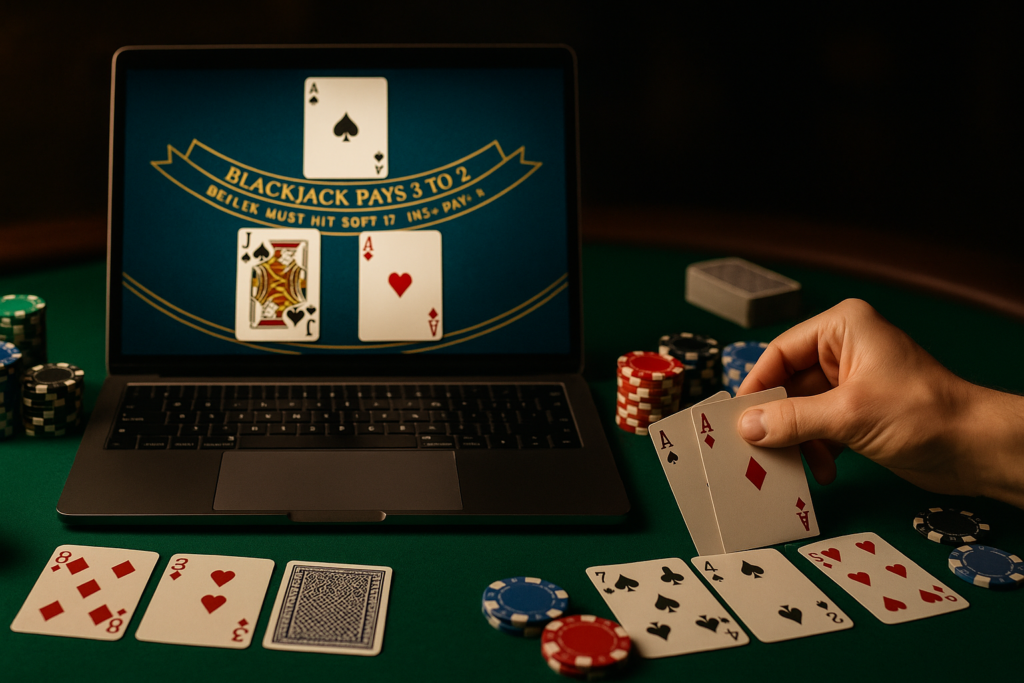
If you’re new to card games and want to get into action quickly, blackjack wins on accessibility. The rules are simple, and basic strategy is a small, memorisable matrix of decisions. Online RNG blackjack removes time pressure and seat availability issues—instant play, lower minimums and the ability to move at your own pace—making it friendly to beginners. BetMGM’s live vs online blackjack guide highlights these practical differences between RNG and live formats and why online RNG is often more beginner‑friendly: betMGM: Live vs Online Blackjack.
Poker carries a steeper learning curve. Beyond learning hand rankings and betting rounds, you must internalize concepts like position, pot odds, implied odds, stack depth strategy, and opponent profiling. Mistakes in poker can be far costlier because every betting decision affects pot size and future dynamics.
Practical advice for newcomers:
- Start at low stakes in both games. In blackjack, use a basic strategy chart and flat betting. In poker, begin in micro‑stakes cash or freeroll tournaments to learn player tendencies without large financial risk.
- Focus on one game long enough to build procedural fluency—learn the mechanics of decision timing in live dealer blackjack, and learn the structural lines (preflop, flop, turn, river) in poker.
Variance, bankroll and who risks what
Variance is where the games feel very different at the table.
Blackjack typically produces lower variance per hand than poker when played with flat bets and basic strategy. Because the house edge is small, bankroll swings tend to be smoother—but remember, “smoother” does not mean “profitable.” Outside of rare advantage situations (counters in live games or promotional play), the expected long‑term outcome for a basic strategy blackjack player is a slow bleed against the house.
Poker carries higher variance. Even elite players suffer long‑term downswings because variance (the luck component of which hands win and when) is baked into multi‑player pots. Proper bankroll management is essential—players commonly discuss having many buy‑ins for a given stake to survive variance. That higher variance is the price of the possibility of being a long‑term winner; unlike blackjack, successful poker play can produce positive return on capital after rake if you consistently beat the competition.
Some practical points:
- If you’re risk‑averse or running a small recreational bankroll, online RNG blackjack with smaller minimums lets you play longer with less emotional whipsaw.
- If you want to pursue poker seriously, accept the swings and size your bankroll to handle extended variance—study the particular format’s variance profile (cash vs tournaments) before moving up.
Online‑specific considerations: RNG vs live, bots, rake and ecosystem
Playing online introduces platform‑specific issues that matter depending on which game you choose.
Blackjack comes in two main online flavors:
- RNG blackjack: Fast, low‑minimum, always available. Because the dealing is simulated by a tested random number generator, you can’t card count—so the game is essentially fixed in structure. The betMGM guide explains the convenience and pace advantages of RNG blackjack: betMGM's live vs online blackjack article.
- Live‑dealer blackjack: Slower, more social, streamed from a casino studio with a real dealer. It’s closer to the land‑based experience, but tables often have higher minimums and limited seats.
Poker’s online landscape is more complex. Two ecosystem factors deserve emphasis:
- Bots and assistance tools: Online poker rooms grapple with the presence of bots and real‑time assistance software. While policing is improving, players should be aware that certain platforms have historically been more vulnerable than others. This affects game integrity and your expected win‑rate.
- Rake, rakeback and game selection: Where you play matters. Sites with high rake or tough player pools erode margins. Conversely, softer sites or good rakeback programs can materially boost your profitability. The Blue Lake primer and industry discussions repeatedly point to rake and field strength as determinative for serious players: Blue Lake Casino's blackjack vs poker overview.
Pro tip: If you’re going to play poker online seriously, shop for soft game pools and favorable rake; if you’re playing blackjack, pick RNG tables for convenience unless you want the live‑dealer atmosphere.
Player profiles: who should play what?
If you forced me to suggest a “best fit” based on temperament and goals, I’d segment like this:
- Pick blackjack if: you want quick sessions, low cognitive load after you learn basic strategy, predictable rules‑based play, and lower variance. Casual players and those who prefer to gamble without the long homework commitment will usually prefer blackjack. For online convenience and lower minimums, RNG blackjack is especially friendly—see betMGM’s breakdown for the online trade‑offs: betMGM guide.
- Pick poker if: you enjoy strategy, psychology, and the prospect of long‑term profits if you put in work. Poker suits players who like studying, adapting, and exploiting opponents. It’s a tougher road but the upside is real for good players; many professionals describe poker as an evolving intellectual challenge—watch interviews with established pros to get a sense of this dynamic: professional players discussion (YouTube).
Both games reward discipline and bankroll management; neither is a guaranteed route to regular winnings for casual players.
Professional potential and advantage play
If your ultimate question is “which game can I beat for a living?”, the short, practical answer from the industry is: poker provides a clearer structural path to consistent profits; online blackjack rarely does unless you find promotional or structural advantages.
Blackjack pros historically have used advantage techniques like card counting, shuffle tracking or exploiting specific dealer errors and promotions to flip the house edge. But those methods are difficult in regulated online RNG environments and often short‑lived in live settings because casinos adapt. Blackjack Review and other longform discussions lay out why sustained online advantage play is tough: Blackjack Review: Online comparison.
Poker professionals succeed by consistently exploiting weaker players and game inefficiencies. The path isn’t easy—game selection, psychological endurance and continuous study are prerequisites—but the model of taking money from opponents (not the house) makes professional poker a realistic career for those who can execute at scale and manage variance. To hear how real pros think about it, see longer interviews and panel discussions such as the referenced YouTube conversation: professional players discussion.
Responsible gambling: play within limits
Everything above assumes you’re treating these games as entertainment first and financial opportunities second. Whether you prefer the low‑variance hum of blackjack or the higher‑variance churn of poker, set limits:
- Decide beforehand what session loss you can afford, and walk away when you hit it.
- Use stake sizes appropriate to your bankroll—especially in poker, where multiple buy‑ins reduce the risk of ruin from normal variance.
- Remember that both games have emotional components—tilt in poker, frustration in long blackjack sessions—that degrade decision‑making. If play affects your mood or finances, seek help. Many jurisdictions provide resources through their gambling regulator or problem gambling services; check local providers for help if needed.
FAQ
- Q: Which game gives me the best chance to win in the long run?A: Structurally, poker gives skilled players the clearest path to long‑term wins because you win from other players after overcoming rake. Blackjack, played with basic strategy in online RNG form, is a small negative expectation for every non‑advantage player.
- Q: Is card counting effective online?A: No. Card counting relies on tracking cards through predictable deck penetration and shuffles—conditions that don’t exist in RNG blackjack and are limited in many live‑dealt online games. Most operator documentation and expert commentary note that online RNG tables are designed to prevent such techniques.
- Q: How important is rake in online poker?A: Very important. Rake is the fee the site charges and materially reduces your win rate. Sites with high rake or poor rakeback programs make profitability much harder for all but the best players. Consider rake structure and game softness when choosing a poker room.
- Q: Which game has lower variance?A: Blackjack generally has lower variance per hand, assuming flat betting and basic strategy. Poker typically produces higher variance, particularly in tournament play, which means larger ups and downs even for good players.
- Q: Can a casual player be profitable at poker?A: Possible but challenging. Casual winners exist where the player pool is soft and the casual player adopts sound fundamentals. However, sustained profitability usually requires study, volume and discipline. Casual players often find recreational enjoyment in both games without pressing for profit.
- Q: Should I start with RNG blackjack or live dealer blackjack?A: If you’re new, RNG blackjack is easier—faster, lower minimums, and no seat pressure. Live dealer tables add atmosphere and social cues but are slower and often have higher minimums. Use RNG to learn and move to live if you want the social experience.
- Q: Are online poker games safe from cheating?A: Reputable rooms implement bot detection and security measures, but the risk is real. Choose licensed sites with transparent security policies and player protections. Monitoring and enforcement vary across platforms and jurisdictions, so diligence matters.
- Q: Can I make a living from either game?A: Some people do. Professional poker is a well‑traveled path, though it requires exceptional skill, game selection and bankroll discipline. Professional blackjack is rarer and usually depends on exploiting specific, often temporary, advantages in live settings rather than online RNG play.
Conclusion
Choosing between online blackjack and poker comes down to what you value: a rule‑driven, lower‑variance game with a small, predictable house edge, or a higher‑variance, strategically rich contest where skill over other players—after rake—can produce long‑term profit. Blackjack is easier to learn and less mentally demanding; poker rewards study, psychology and adaptability.
Neither is a shortcut to easy money. Play responsibly, pick the format that matches your appetite for study and volatility, and make platform choice (rake, player pool, RNG vs live) part of your decision. If you want to start playing without spending your own money, you can claim the free betsson bonus.
Whichever table you choose, make the game part of your entertainment budget, respect the math, and enjoy the unique kinds of fun each game delivers.