
What is Roulette and How Do You Play It?
If you’ve ever passed a casino table and watched the little white ball bounce around the wheel, you’ve seen roulette in action: the theatrical, simple-looking game that’s equal parts suspense, math and pure chance. Pull up a chair — I’ll walk you through what roulette actually is, how a round plays out, which bets matter, and the practical stuff that helps you enjoy more spins and fewer surprises.
What is Roulette? A quick primer
At its core, roulette is a casino table game where players bet on which numbered pocket a small ball will land in after a wheel is spun. The name comes from French for “little wheel,” and the modern game likely evolved from older Italian and French games. Roulette is a banking game: bets are placed against the house, not other players, and the casino pays winners according to fixed payout odds. For a concise encyclopedia-style description, see Britannica’s entry on roulette and the technical breakdown at Wikipedia.
Why this matters: unlike poker or blackjack, you aren’t competing against other people — the wheel and the house rules decide your fate. That changes how you approach risk, stakes and bankroll planning.
Equipment and the layout: what you’re really betting on
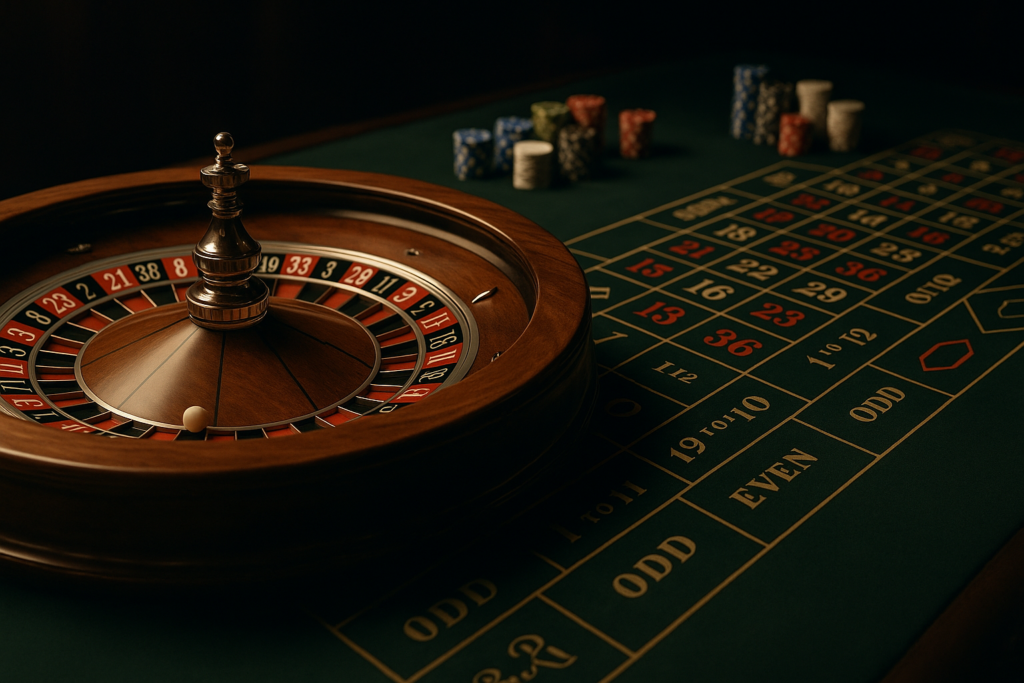
Roulette uses a rotating wheel with numbered pockets and a felt layout that mirrors those numbers, plus areas for group bets. Most wheels have numbers 1–36 colored red and black, and one or two green zero pockets depending on version. The dealer (croupier) spins the wheel one way and launches the ball the other; the ball eventually drops into a pocket after bouncing off deflectors — that’s your result.
There are a few practical details players should know:
- European-style wheels have a single green 0 (37 pockets); American wheels add a 00 (38 pockets). That extra pocket matters for house edge — more on that below. See a quick guide at Metropolitana Casinos’ roulette guide.
- The felt or betting layout shows every number plus the outside bets (red/black, odd/even, dozens, columns). Where you place chips — directly on a number, on a line between numbers, or in the outside boxes — defines the bet type.
- When you sit at a live table, you’ll get table-specific colored chips so the dealer can tell which bets belong to which player. Those chips usually have value only at that table and need to be cashed out before you leave. Casinos explain this in their how-to-play pages, for example at The Venetian’s roulette basics.
The objective and the kinds of bets you can place
Simple objective: predict where the ball will land. But “predict” here means selecting a single number, a group of numbers, a color, odd/even, or other groupings such as low/high or dozens. Different wagers come with very different payouts and risk profiles.
Bets fall into two broad categories:
- Inside bets — placed on specific numbers or small number groups on the inner grid. They pay larger amounts if they hit (for example, a straight-up single-number bet is typically listed at 35:1).
- Outside bets — placed around the grid (red/black, odd/even, 1–18/19–36, dozens, columns). These cover more numbers and pay less, but they offer more frequent wins and smoother swings.
Examples and typical payouts (common across many casinos): a straight-up is 35:1, a split (two numbers) is 17:1, a street (three numbers) is 11:1, a corner (four numbers) is 8:1, and outside even-money bets are 1:1. These payout figures are standard in most guides; for a practical beginner’s breakdown see an accessible primer at Apache Casino Hotel’s roulette for beginners.
Why this matters: inside bets are high-variance — big wins but rare — while outside bets smooth volatility. Your choice tells the story of whether you want excitement or endurance from a session.
How a single round of roulette plays out
Understanding the sequence removes confusion and reduces mistakes at the table. A typical live-round sequence looks like this:
- Buy-in: Exchange cash for table chips (colored chips for your seat). The dealer notes the value of your chips when you buy in.
- Place bets: You place chips on the layout for inside and/or outside bets. You can make multiple different bets in the same spin within table limits.
- “No more bets”: The dealer spins the wheel and ball, and when the ball is settling they will call “No more bets” (or the French “rien ne va plus”). At this moment you must not touch chips; attempting to change them after the call is a violation.
- Result: The ball falls into a pocket. The dealer announces the winning number and color and places a marker (the “dolly”) on the layout.
- Payouts: Losing bets are cleared; winning bets are paid at the table’s stated odds, the marker is removed, and the next round begins.
For a friendly step-by-step you can review Riverwind Casino’s quick guide to playing roulette at Riverwind’s “How is Roulette Played?”.
European vs American roulette: the single most important choice
If you only take one strategic tip from this article, let it be this: prefer European (single-zero) wheels over American (double-zero) wheels when you can. The single extra 00 pocket in American roulette increases the house edge significantly.
To put numbers on it:
- European roulette (one 0, 37 pockets) has a standard house edge of about 2.7%.
- American roulette (0 and 00, 38 pockets) has a house edge of about 5.26%.
Why this matters: house edge is the mathematical advantage the casino has over the long run. A 2.7% edge means you lose, on average, $2.70 per $100 wagered over time; 5.26% doubles that expectation. For more detail on the differences and why they exist, read the comparative guide at Metropolitana Casinos’ roulette guide.
Strategy, variance and bankroll—what actually helps (and what doesn’t)
Roulette is a game of chance. No betting system eliminates the house edge. That said, some practical approaches improve your experience and control risk.
Things that help:
- Pick the right wheel: choose single-zero European wheels when available to cut the house edge in half compared with American wheels.
- Match bets to mood and bankroll: If you want more action and big swings, favor inside bets; if you want longer play and smaller up-and-downs, favor outside even-money bets like red/black or odd/even.
- Use betting systems only for discipline: Systems like Martingale (doubling after a loss) can keep you playing longer and force discipline, but they don’t change the long-term odds — and they can hit table limits or drain your bankroll fast. Treat them as money-management patterns, not magic bullets.
- Set limits and stop-losses: Decide in advance what you can afford to lose and what win amount will have you cashing out. Roulette is entertainment; bankroll rules keep it that way.
Why this matters: variance is real. A run of losses can wipe out gains quickly, especially with aggressive progressions. Making choices that match your temperament helps you enjoy the game without unpleasant surprises. For a practical house-edge and strategic overview, see the casino-style introductions at Turtle Creek Casino’s how-to-play page.
Table etiquette and practical tips for live play
Roulette tables are social and a little theatrical. Learning the etiquette keeps you comfortable and respected at the table.
Key etiquette and tips:
- Check posted limits: Minimums and maximums are posted at the table; some areas of the table might have different limits. Don’t assume a bet is allowed until you confirm with the dealer.
- Use your color chips: Each player’s chips are color-coded; keep them on the table so the dealer can see who they belong to. Remember to cash them out before leaving the table.
- Don’t touch chips after “no more bets”: That call is final; touching chips can be treated as an attempt to cheat or as a rule violation.
- Ask questions: Dealers expect beginners and will usually show you where to place a split or a corner bet. It’s better to ask than place the wrong chip and cause a dispute.
These practical pointers are standard at most casinos; see house guidance like the Venetian’s roulette rules for an example of how casinos present this information: The Venetian’s rules.
Quick glossary: terms to know
- Croupier (dealer) — the person who runs the wheel, spins the ball and manages bets.
- Dolly — the marker the dealer places on the winning number on the layout.
- Straight-up — a bet on one number (pays 35:1 typically).
- Split / Street / Corner — inside bets covering 2, 3 or 4 numbers respectively.
- Even-money (outside) bets — red/black, odd/even, low/high (pays 1:1).
FAQ
1. Is roulette purely luck, or can I use a strategy?
Roulette outcomes are random enough that no strategy removes the house edge. You can manage risk with bet selection (inside vs outside) and bankroll controls. Betting systems like Martingale change the pattern of wins/losses but don’t change expected losses over the long run. See casino overviews for the math behind this at Metropolitana Casinos’ guide.
2. Which is better: European or American roulette?
European roulette (single zero) is generally better because it has a lower house edge (~2.7%) compared with American roulette (~5.26%) due to the extra 00 pocket. When you have the option, choose single-zero tables.
3. What does “35:1” payout mean?
“35:1” is the standard payout quoted for a straight-up (single-number) win. It means the table pays 35 times the stake for a winning straight bet. Payout conventions can be shown on table signage or in casino guides like Apache Casino Hotel’s beginner guide.
4. Can dealers or players influence the outcome?
Casinos use regulated wheels and procedures to ensure fairness. While there are historical stories about biased wheels or advantage play, modern casino wheels and surveillance make such scenarios rare and unacceptable. Stick to reputable casinos and regulated environments to minimize risk.
5. What are the safest bets to make?
“Safest” in roulette usually means lower variance: outside even-money bets (red/black, odd/even, low/high) cover 18 numbers each (excluding zeros) and pay 1:1. They give more consistent small wins but still carry the house edge.
6. How much should I bet to start?
Start with an amount you can comfortably lose. Check the table minimums and consider how many spins you want to play — if you want longer play, spread your bankroll across many small bets rather than a few large ones. Set a loss limit and a cash-out goal ahead of time.
7. Are online roulette games the same as live tables?
Online roulette follows the same rules and bet types, but you’ll often see RNG (random number generator) versions and live-dealer streams. Confirm whether a site uses live wheels or RNG and play on licensed sites. For how-to-play basics you can compare live guidance (for instance at Riverwind’s guide).
8. What should I watch for at the table as a beginner?
Watch the wheel type (0 vs 00), posted table limits, chip colors, and the dealer’s “no more bets” call. Ask the dealer if you’re unsure where to place a split or corner bet — they’re used to teaching beginners.
Conclusion
Roulette is wonderfully approachable: the rules are simple, the action is dramatic, and the bets let you tune your experience from slow-and-steady to high-risk thrills. Remember these essentials: choose single-zero wheels when possible, know your bet types and payouts, respect table etiquette, and treat any betting system as a money-management tool — not a way to beat the house.
If you walk away with a better understanding of the wheel, the layout and the math behind bets, you’ll get more enjoyment out of each spin. Play responsibly, set limits, and enjoy the click of the wheel — that’s where the excitement lives.
Useful reading while you practice: an overview of roulette history and rules at Britannica, a technical summary at Wikipedia, and user-friendly casino guides like The Venetian, Turtle Creek Casino, and Riverwind.